

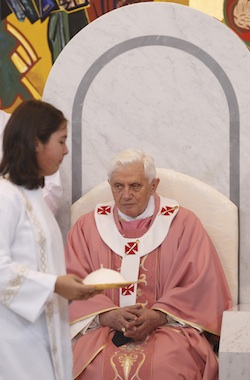
This is not a local story, but one that represents larger trends in the church—in the priesthood, the liturgy and in the role of the people of God. Recently Sts. Simon and Jude Cathedral in Phoenix, Ariz., changed its policy on altar servers. From now on only boys may serve; girls may apply for jobs as sacristans. Why? The rector of the cathedral told The Catholic Sun that the cathedral is not alone in making this regulation. A parish in Ann Arbor, Mich., and the Diocese of Lincoln, Neb., he argues, have found that replacing girls with boys as servers leads to more vocations to the priesthood.
These moves to limit laywomen’s access to the altar threaten to drag the church back into the pre-Vatican II world. One wonders if next the altar rail will return, another barrier between the priests and the people.
According to the rector, people who are upset about this decision concerning Mass servers make a mistake in considering it “a question of rights,” as if someone’s rights were being denied. But, he says, no one has a “right” to be a server or even more a priest. One must be “called” to any church office. When the secular world comments on who should be an altar server, he says, it has only an emotional view, unguided by the light of reason.
The key issue is the status of the baptized: that the laity may be called by the Spirit to offer their talents in various roles. The rejection of altar girls disregards the counsel of the Second Vatican Council that the charisms of the baptized “are to be received with thanksgiving and consolation.” By virtue of baptism, the council reminds us, “there is neither male nor female. For you are all ‘one’ in Christ Jesus.” There is “a true equality between all with regard to the dignity and activity which is common to all the faithful in building up the Body of Christ” (“Dogmatic Constitution on the Church,” Nos. 12, 32).
That this call should be fully welcomed does not appear to be a priority in Phoenix. Yes, the Vatican instruction “Sacrament of Redemption” (2004) allows women servers, but it leaves the decision to local bishops. In Phoenix the bishop leaves it to the pastors. This pastor did not consult the parish council, he says, because its members are not theologically trained.
Another issue is the image of the priesthood today. Is it wise to re-enforce the sense of the priesthood as a clerical caste? Is the acolyte supposed to be like the page who serves Sir Galahad until King Arthur dubs him a knight? In a culture where parents want their daughters to have the same opportunities as their sons—in co-ed Catholic colleges, in the armed services, in athletics, in employment—the church can look irrelevant, even foolish, in shunting them aside. The more the priesthood is presented as an exclusive club, the smaller and more remote it will become. Those who put up barriers between themselves and the people should, using modern parlance, recall Jesus’ words to his disciples: “Look, how many times do I have to tell you? You are here to serve.”
Inevitably the issue of women’s roles in the church raises the question of women’s ordination to the priesthood. Recently a cardinal in Lisbon and some bishops in Brazil, among others, also raised the question; but since Pope Benedict XVI, despite continued agitation, has reaffirmed the policy of John Paul II to allow no discussion of the topic, the matter of altar servers must be considered a separate and independent issue.
In no way should policies imply that women are second-class citizens—welcome to tidy up the sacristy, arrange flowers and clean linens but not to set the gifts at the altar or hold the sacramentary or censer. Rather, they must be welcomed into every service and leadership role, including catechists, lectors, chancellors and general secretaries of bishops’ conferences. (The diaconate for women remains an open question and ought to be explored.) Churches that invite all their people to bring all their talents to the welfare of the congregation will thrive. To tell a young woman that she may no longer pour the water on the priest’s fingers at the Lavabo looks like sexism. If the ban in these dioceses continues and spreads, perhaps women and girls will consider withholding their other services to the parishes, and men and boys, in solidarity with their sisters, will decline the honor of acolyte.
Having girls share serving opportunities with boys is an expression of their equality in Christ. Parishes must create a variety of social and service activities. A distinguishing characteristic of today’s young men and women, even when they are not “devout” in the usual sense, is their rejection of discrimination in any form. They are highly sensitive to any hint of exclusionary policies in organizations. Perhaps if more young people believed they could continue that commitment to equality as priests, more would be ready to follow a priestly vocation.



The pastor did not consult the pastoral council because he would have had extreme push back. The pastoral council would have used its pastoral sense , that's why it's existance is mandated.... pastor. So saying they have no theological creds is an outright falsehood and extreme disrespect of canonical processes. However, these betrayals are OK in the eyes of the Trads in their guerrilla war against Vatican II. Partisans will always say 'Alls fair in a dirty war'..
According to the rector, people who are upset about this decision concerning Mass servers make a mistake in considering it “a question of rights,” as if someone’s rights were being denied. But, he says, no one has a “right” to be a server or even more a priest. One must be “called” to any church office. When the secular world comments on who should be an altar server, he says, it has only an emotional view, unguided by the light of reason.
There is an obvious problem with this statement by the rector: The church is consistent in denying that women can even receive a call to the priesthood, assuming that if it is a woman it cannot be a call from the Holy Spirit. How is that not a question of rights? How is questioning this sexism not reasonable?it is time for the Church authorities to stop hiding their sexism behind the claim that they know when and to whom the Spirit speaks. Any reasonable, theologically trained Catholic absolutely knows that no human agency controls whose heart God's Spirit touches. Sadly, theologically trained priests and bishops seem to have lost their sense of reason. It is therefore up to our reasonable, theologically trained laity, and there are many of us out there, to stand up and challenge these pseudo-rational claims.
As the rector mentioned in this piece, I feel compelled to respond to the distortion and emotionalism contained herein, but the sheer amount of slant makes it tremendously difficult to even know where to start. It seems best for me to being with my exact words to the good assistant editor who contacted me. I told him:
"As the rector, I am the chief liturgist of the parish. I do not, as a general rule, consult our Parish Council on liturgical matters since the typical parish council (and ours, specifically) is not comprised of members formally trained in theology and liturgy. As many in the media have demonstrated clearly, the absence of formal theological and liturgical training leaves far too many individuals evaluating this decision from purely emotional, subjective standpoint. Such decisions require a proper understanding of theological anthropology, sacramental theology and ecclesiology, as well as a willingness to examine honestly what contributes to, and what detracts from, priestly vocations. Naturally, I consulted with the bishop, as he is the canonical pastor of the Cathedral. But he leaves the final decision and implementation to me."I have bolded and italicized part of my statement because this particular opinion piece demonstrates in black-and-white, exactly the point I was making about a preferential option for emotionalism and ideology. Unlike a committee which lacks formal theological training (like the average parish council) the Jesuit assistant editor who contacted me, and who, presumably, wrote this piece, modeled precisely the emotionalism to which I referred, despite having the requisite theological training.
To go point-by-point through the article to unmask the distortions would require far more time and effort than I have available to invest, so I’ll highlight just a few of the distortions here:- “The policy of John Paul II”. (Could you not, at least, have referred to him as “Blessed” or “Pope”?) Presenting the Holy Father’s clear articulation of the Church’s teaching as a policy is a transparent attempt to frame Church teaching as arbitrary and, therefore, changeable.
“ Fr. ______, I look forward to reading a complete and accurate presentation of my statement in your publication, should your article make it to print.”I responded in good-faith to his request for an interview. Sadly, I did not receive a good-faith treatment in this opinion piece.
As food for thought for the readers of America Magazine: If you ever read that an individual featured in an opinion piece like this one responded, “No comment”, please understand that this does not automatically mean the person is afraid to confront a difficult issue. More often than not, such a comment is made out of frustration of having one’s words distorted, truncated or slanted one too many times, as mine were here. For someone who has never had their words manipulated in the media for ideological purposes, no explanation will suffice. For someone who has had such an experience, no explanation is necessary.St. Ignatius of Loyola…PRAY FOR US!
AMDG,Very Rev. John T. Lankeit
RectorSs. Simon & Jude Cathedral
Phoenix, AZAs I get older,it has been pointed out to me by my kids, I'm getting more impatient, grumpier and tend to look back to the "Golden Age" of the my youth in the 60's and go on and on and on..I try to fight thiese attitudes.I want to remain a person of dignity with something relevant to say not just a moaner ! I feel I am making progress.Anyway, once pointed out to me,I have now noticed that this attitude is wide-spread among oldies of my age group! !
Do you think that clerics in their 80's or 90's have a magic potion which protects them from being 'old farts'-mitres not-withstanding ? How many old people fear the future,are suspicious of change and take refuge in nostalgia! All this to say that I do not think that a lot of the arguments around issues in the Church, role of women in the Church,celebacy etc etc are really about theology, but simply emanate from ageing leaders who can't cope. God forgive me, but I have to say step aside, in the name of God and do not obstruct the Gospel.
From your mouths to God's ears. I am sure She is listening.
His parishioners may not have degrees in theolgy, but Fr. Lankeit could benefit from a course in Sociology 101. A dose of old fashioned commonsense, alas, is probably too late to expect.
@ Very Rev. John Lankeit:
Thank you for commenting and weighing in on this discussion. It is good to be CLEAR about opposing views, since it helps to frame the discussion. Also, I understand a few things better than I did before, such as altar service being an early preparation or exploration for a priestly vocation.
You mentioned the idea of the priestly identity, the Sacramental character, of the priest, and the theology of the priesthood. I think this subject, alone, is worth a couple of posts and discussions. The notion of the Sacramental character came up, earlier this year, in a critque of Blessed John Paul II's expectation that it would lead to the rehabilitation and redemption of offending priests who abused children. My personal view was that his faith was misplaced.
Mona Villarubia challenged your position that the issue of Mass Servers is not a 'question of rights' as we tend to understand 'rights' in America. I understand your position from the vantage point of Church prerogatives and tradition. I think this is another important issue to discuss.
I've criticized those who equate Christianity with Western civilization, or who elevate the U.S. Constitution to a level of near parity to the Hebrew bible and the Christian Testament, or who can only see a 'born again Christian' as the only suitable candidate for the U.S. Presidency. Yet, we do see fundamental rights, as we understand them, to be endowed by a creator and unalienable. These are understood by believers and non-believers who see them as self-evident.
What almost all Americans do not understand, including most Catholics, is that our Constitution and democracy were looked upon as just plain wrong, if not near evil, by Popes up through Leo XIII and after. Our understanding and pronouncement of 'rights' was viewed with seething hostility in some quarters of the Vatican. Americanism would have been considered, long ago, the stuff of mortal sin and cause for excommunication if not for the deft handling, persuasiveness, and political skills of the American bishops since the founding of our Nation.
John Cooney's book about Francis Cardinal Spellman, The American Pope, was an acknowledgment, at long last, of a de facto American Catholic Church.
I think the Very Rev. John Lankeit is more than worthy of our respect and considered opposing opinion. He has taken the time to be clear about his views and give us an opportunity to debate the matters. I don't see him being contemptuous of the other commenters.
About the laity not having the theological background to participate in church related decisions, I have to respond that theological reflection is not just about tradition and church teaching but also about listening to the experience of the faithful. Otherwise how can the Catholic Church be relevant and connect with those she is trying to serve.
We live in modern times with modern challenges. Not some past age in which men were ordained to a series of offices: porter, lector, exorcist, acolyte, subdeacon, deacon, priest.
Today’s equivalent adult roles include readers, Eucharistic ministers, catechists, choir members, cantors, social ministries, etc. “Server” tends in most parishes to be exercised by only children and adolescents.Today’s challenge is to involve as many children and adolescents in as many parish ministries as possible so that they develop life long patterns of parish involvement. If we do not do this as our major priority we will not need many priests! We have to get away from an education model to a practice model of passing on the faith.
The more children and adolescents that we involve in all these practices, the more of them that will consider becoming priests and religious as well as practicing these ministries as adults.As for any specific ministries for future priests, they should experience as many as they can personally so that they will be better pastors in the future and related better to all the ministries of the parishes. It is ok to be a server for a couple of years, but that should be followed by being in the choir, taking communion to shut-ins, teaching catechism to very young people, etc.
In other words before becoming a priest be a model well rounded modern lay person.This decision, though licit, makes the Church look small. It does not build up the Body of Christ. The decision merits scorn.
Your agenda is to "push" young females into positions for them to break down your misguided theology making women into priests. Shame on you
It is very difficult sometimes to be charitable in the face of an outrage. Msgr. Lankeit is visibly a very good practitioner of the admonition to be "as wise as serpents, and gentle as doves". But in the wider context of the direction the Church is taking, the exclusion of altar girls is not only in itself a serious error, but one of a series of retrograde actions to turn back the clock to the pre-Vatican II era. Putting the tabernacle back behind the Altar, the New English Language Missal, the elevation of the hierarchy by placing barriers between clergy and people, having the altar turned to the back wall, (hardly likely in some centrally planned churches), are all part of a 'death by a thousand cuts'. Many lay persons were worried about some of the excesses and liberties taken after Vatican II. But most questionable enthusiasms have been corrected. The concerted, surreptitious return to pre-Vatican II days must be rigorously challenged. In such circumstances, clear, unambiguous assertion sometimes trumps the niceties of expression. There were many reasons for Vatican II. Old, outmoded ways needed correction. We have them. But for how long?
- The “image of the priesthood today”. The obsession with priestly “image” is the problem. The first step in ending the confusion/distortion for this publication’s readers would be for the editor to share Vatican II’s actual teaching on the identity (i.e. Sacramental character) of the priest. That is, unless one dissents from the Church’s theology of priesthood.
This separation of priest from laity (alter girls, lectors, Eucharistic ministers, parish councils) drives me crazy. I have heard this tone before. It is the tone of the superior male cleric, and that tone is already there in their twenties. Arrogant, distant, theologians, they shun women. They are not pastors. They quote the Vatican, they quote the Catechism of the Catholic Church, they threaten excommunitcation if you disagree, and then to top it all off, they forbid girls to be on the alter.Where is the joy? Where is the sense of community? Where is the equality?
Let's have Vatican III.
It's not simply a matter of John Paul I's not allowing discussion of women priests. John Paul II, exercising the authority Christ gave to Peter, reaffirmed the teaching of the Church that it lacked the authority to ordain women to the priesthood. Cardinal Ratzinger, now Benedict XVI, in his role as Prefect of the Congregation of the Doctrine of the Faith, ruled that this teaching belonged to the deposit of the Faith and had been set forth infallibly.
It should also be noted that all Churches that trace their lineage to the Apostles fully share this teaching. Any move to ordain women priests in the Catholic Church would be viewed as breaking with Apostolic tradition by the Eastern Orthodox and Oriental Orthodox and end any hope of reunion with the Churches of the East."America Magazine is a near occasion of sin...".
The same, and worse, was believed by some Popes concerning the U.S. Constitution and Democracy. Among the many sinful aspects of Americanism were (1.) too cozy a relationship between American Catholics and non-Catholic Christians, and (2.) the American sentiment that salvation was readily available to people of other faiths.
Things did not work out well for Italians, though. By the millions, they were excommunicated by Pope Pius IX for participating in, and voting for, a secular government. The new unification of Italy into a single Nation put an end to the temporal power of the Church and it's rule over the former Papal States. There was nothing 'near' about the occasion of all those Italian sins and sinners.
I would hate to think that a spirited discussion of challenging ideas would be viewed as a near occasion of sin. I can't think of a more effective way to bring thought and analysis to a screeching halt - even before the discussion begins.
The pre-Vatican II, 1950's church culture resulted in most of the baby boomers leaving the church. I am mystified by the apparent desire to resurrect the most disastrous era in recent Church history.
We are in a Catholic Church that is hemorrhaging members on a daily basis. Perhaps Father Lankeit, born after Vatican II, thinks all will be well if we can turn the clock back; make the Church a bit more exclusive, quiet the rabble, get rid of communion in the hand, get rid of women on the altar, and suddenly the seminaries will be full again.
It is a shame that he feels so far above his parish council that he does not need or value their input. The "my way or the highway" attitude, especially for a man with an undergraduate degree in psychology, seems .. gee... like the Church in the 50's.
That seems like you are blaming women - or in this case, girls and young women - for the decline in the number of priests. Yes, yes...I like that..let's blame women for any perceived failing in men...good.
But wouldn't that be like blaming cultural confusion of say the 1960s for the rape of children....oh, there goes that silly emotionalism again.
And of course, we would want to reinstate a culture that would put men of almighty authority in close, secretive proximity to young boys again...now wouldn't we...free of those prying, knowing eyes of women...or in fact are those sins also to be placed at women's feet...
Father, the reasons for the decline of the number of priests has more to do with the lack of relevancy the church has today to Jesus-loving Christians of all genders than poor boys confused because their classmates and chums are serving with them on the altar. And when I say "relevancy," I don't mean trends or those every shifting cultural sands that the church of course must stand firmly against - progress in human understanding is afterall something the church has been so good at thwarting. By relevancy, I mean whether such a repressive, demeaning, elitist organization actually is in synch with a loving God, a saving Jesus or the Holy Spirit.
Father, the decline in the number of priests has more to do with the attitudes of men like you who actually are the ones deaf to the Holy Spirit, not these young men who have a much more healthy attitudes toward women than you clearly have. I will pray for you and the Church..may God save you both.
It's not so much hatred of women, but fear that decides issues like this one.
A call is not something decided by a pope, bishop or priest; it is something that comes from a God who created men and women who could follow the example of Jesus, the only human being who showed us how to live our lives without fear or hostility.
As long as the hierarchy keeps rearranging the deck chairs, the Catholic Church will contine to implode.
When I asked the students in one of my honors English classes last year to enumerate the finest ideals of womanhood, why did they seek to exclude modesty and selflessness? They told me it was because that would make them seem "weak," and they needed to be strong, "like men."
Until we recognize that Mother Mary has gone out of the world for too many of our young women, our young men will continue to flounder, and so will our society.
There it is: men's problems today can be blamed on women. "Jane Crowism" is back.
In writing about a "willingness to examine honestly what contributes to, and what detracts from, priestly vocations" Msgr. Lankelt seems to calling into question the character of his parish council.
I also work in a parish where a great many men have decided to pursue the priesthood. I have never seen a correlation between whether there are girls and women serving at the altar and the results in vocations. When I worked in parishes where females never served, we also never had a vocation come from the parish.
There are a myriad of reasons why someone feels called to the priesthood, beginning with the promptings of the Spirit, of course. I think that they include a sense of joy and satisfaction in the priests they know, as well as reverent liturgy, quality preaching, an emphasis on how all of this should take root and flower in our daily lives.
Vibrant parishes are also key. Who wants to join a moribund institution, only to die a slow death of frustration and boredom?
The third thing that I think leads to encouraging vocations is a sense of fidelity to the tradition and the spirituality that flows from it. I find this in both those who are called to priesthood as well as those who are called to lay ministry. They want to be the next page in that 'book of tradition', handing down the faith we received from the apostles. They don't want to be Sufis or be promoting Hindu spirituality, or some sort of eco-Buddhism. They want to be Catholics, to know that they are Catholics and to encourage others to meet the Lord as Catholics.
Priests and parish leadership who invest their energies in those three goals - building vibrant parishes, encouraging a healthy sense of the 'Catholic difference' and finding joy in ministry - will see others who want to serve the church.
If we worked on those priorities, it wouldn't matter who served at the altar.
You quote, and then write:
"Has our denial of the complementarity of the sexes, especially in America, led to our boys' overall failure in life these days?"
There it is: men's problems today can be blamed on women. "Jane Crowism" is back.
This is typical of the response I get when I ask people to consider the fact that complementarity of the sexes is recognized as TRUTH-rather than mere ideology-in the Chuch. Rather than and ad hominem attack, can you talk instead about what I'm really asking about:
1) Why do we feel modesty and selflessness are less-than-ideal goals to promote in our young women?
2) When women want to be "more like men" in every way-especially when it comes to promiscuity, ultra-competitiveness, "market" values above all else-does it hurt our overall society?
3) How is it that amazing women like Mary Ann Glendon, the Learned Hand Professor of Law at Harvard, can understand the need for complementarity-and the scourge of abortion-and still be as successful in her professional life as she has been?
As for the notion that I'm suggesting that women are to blame for all of men's problems, I'd say you are half-right. You see-I'm for equality after all.
The fact that we can't even discuss such a possibility, and the failure to understand the deep significance of motherhood, modesty, and selflessness, is the reason we live in such a fragmented society today.
@Kathy
You say: I don't need Bill M. to define femininity for me, nor do I need him to define masculinity for my sons.
"Bill M" isn't defining anything. If I were, than you would be right to ignore me. The Church teaches that men and women are fundamentally equal AND complementary. That isn't "my" truth-it is supposed to be "the" truth.
Look, I know I am not going to change anybody's mind here. If that were my purpose, you'd be right to rip me, because I'd be overstepping my bounds. I'm just trying to stand up for the truth: the truth the Church teaches us. Now, I have come to believe deep in my heart and soul that the complementarity of the sexes is true, and that a full understanding of this truth will lead us to live happier lives. But you shouldn't care that I think or say that.
You should care about whether or not what I pointed to-the need for modesty, selflessness, motherhood as the highest ideals of womanhood (as fatherhood should be the highest ideal for males, by the way!)-is true, and good, and beautiful.
So Kathy-forget me. Don't lose sight of truth though.
Year after year, our diocesan newspaper trumpets all its new ordinations: male permanent deacons shown prostrate on the floor of the cathedral and vowing themselves in obedience to their bishop.
Deep beneath the streets of Rome, in chambers where early Christians held and hid their rituals, the walls show women presiding at tables where bread was broken and shared and Jesus remembered. That was the reality of the lived Gospel then. How have we forgotten so much? Why is our church so afraid of women (even the miniature version) when it comes to the altar or the ambo?
Please tell me though: why do you keep mentioning "modesty" with regard to women alone? Do you mean humbleness? or do you mean modesty in the sense of discretion and chastity - modesty in dress, behavior, and attitude? Does this then suggest that modesty or the lack of modesty is exclusively a problem for women?
This is of course related to the discussion topic because you seem to believe that a failure to see "modesty, selflessness, motherhood as the highest ideals of womanhood (as fatherhood should be the highest ideal for males, by the way!)" contributes somehow to the scarcity of men called to the priesthood. So, logically, it is because women are immodest, selfish, and eschewing motherhood that we have these problems. Aside from the fact that in making this argument, you are implicitly saying men are so weak as to be rendered emasculated by strong women and incapable of hearing God's call, why the repeated reference to modesty? And aren't men and father's called to selflessness, too?
Like the church of old you embrace, you are revealing a limiting, repressive view of women - you are blaming women for the ills we are discussing and exhibiting in so doing a fundamental failure to appreciate that God made women diverse and that being modest and selfish are not exclusively related to motherhood. You can't be a good mother without being those things but you can't be a good person in general without them. Women, and our culture that allows them to live their lives according to their own values, are not the problem. The problem is that the Holy Spirit is not calling people to the church. That is obvious whether you look in the pews or the seminaries. Perhaps that is because the Holy Spirit is trying to tell the Church something while calling people to serve and worship God in other, more loving ways.
I'm sorry you feel the need to blame women for so much - yes, you'll say you blame the culture not the women themselves but really, that's just a way to sugar coat it. I will pray that you can accept women as multi-dimensional and that you can teach your pupils to do so, too.
The problem in Phioenix as in the tarditionalist approach is Father/Msgr, etc. is the answer man and the laty , even those on a parish council, are not sufficiently intelligent and too emotional.
A sort of broad ad hominem from the pastor there, who, I think, is not very pastoral, but very taken with his position.
That kind of posture is not ony alienating but indicative of a terible gulf that needs to breached -something the editors here have tried to point up.
Going, Going, Gone, altar girls, the latest sign of the revisionist spirit that has entered our Church, beginning the dismantling Vatican Council II. Gone too, the buoyant refrain of Bl.JPII, “Do not be afraid,” being replaced with the tight triumphalistic maniple mentality of the pre-Vatican II Church, bogged down with such things as black Dracula-like clergy capes, gaudy tasseled-sash cassocks, waist-length lace albs ( gone the more masculine in-ostentatious linen vestures) and pom pom Birettas and so much more. Clericalism is coming back, a clear manifestation of the fear of the laity, especially women!
Or is all of this linked to the quest for unity between Orthodox Christianity and the Catholic Church? I say this remembering what an Orthodox priest once told me, that, a great hinderance to Orthodox/Catholic unity is the presence of laity in the sanctuary, especially women!
Personally, I see nothing wrong with altar girls and for that matter with women serving as lectors. In fact why not allow women in the deaconate? JPII did say that the deaconate is not part of Holy Orders, but separate from it. And I’d even like to see some enlightened Pope in the future name laity, women, men, married or single, to the College of Cardinals, not eligible of course for election to the Papacy, but serving simply as advisors and electors of the Pope. And useful perhaps on diplomatic missions.
But admittedly, I am conflicted in that I do not support women in the presbyterate because Bl.JPII said that his teaching on that subject was “definitive” some say, “ex cathedra” which seems to me to pretty much close the book!
The Gospel of Luke dealing with the Annunciation further conflicts me, as the Second Person of the Blessed Trinity had no difficulty in accepting the ministry of the girl virgin Mary. If anyone ever served the altar of the Lord and announced the Word, Blessed Mary certainly did! - But then things are being revised - so it doesn’t matter?