

 On Sunday, after his colossal “Restoring Honor” rally in Washington, D.C., Glenn Beck took aim at one of his favorite targets, Barack Obama, but in a novel way. Beck regrets saying a few months ago that President Obama was a “racist.” What he should have said instead, he now realizes, was that he didn’t agree with Obama’s “theology.” And what is Obama’s theology, according to Beck? Liberation theology, of all things.
Here’s Beck’s definition:
I think that it is much more of a theological question that he is a guy who understands the world through liberation theology, which is oppressor and victim….That is a direct opposite of what the gospel is talking about…It’s Marxism disguised as religion
As Ronald Reagan used to say, “There you go again.” A few months ago, Beck decided that he would demolish the idea of “social justice,” by telling Christians if their priests, pastors or ministers use that buzz word on Sundays they should leave their churches. As he may or may not have known, the tenets of “social justice” encourage one not only to help the poor but address the conditions that keep them poor. He called that “communist.”
That approach didn’t work all that well for Beck since so many Christian denominations, particularly the Catholic Church, espouse social justice explicitly. But liberation theology? Really?
A little history: Liberation theology began in Latin America in the 1950s and 1960s, and was later was developed more systematically by Catholic theologians who began to reflect on experiences of the poor there. The term was coined by the Rev. Gustavo Gutierrez, a Peruvian priest, in his landmark book A Theology of Liberation, published in 1971. Briefly put, liberation theology (and there are many definitions, by the way) is a Gospel-based critique of the status quo through the eyes of the poor. Contrary to what Beck implies, the liberation theologian doesn’t see himself or herself as victim; rather proponents call us to see how the poor are marginalized by society, work among them, advocate on their behalf, and help them advocate for themselves. It has nothing to do with seeing yourself as victim. It is, like all authentic Christian practices, “other-directed.”
Perhaps more importantly (at least in my reading), it sees the figure of Jesus Christ as the “liberator,” who frees people from bondage and slavery of all kinds. So, as he does in the Gospels, Christ not only frees us from sin and illness, Christ also desires to free our fellow human beings from the social structures that keep them impoverished. This is this kind of “liberation” being espoused. Liberation theologians meditate deeply on Gospel stories that show Christ upending the social structures of the day, in order to bring more—uh oh—social justice into the world. We are also asked to make, as the saying a “preferential option for the poor.”
It’s not hard to see what Beck has against “liberation theology.” It’s one of the same reasons some people are opposed to “social justice.” Both ideas ask us to consider the plight of the poor. And that’s disturbing. Some liberation theologians even consider the poor to be privileged carriers of God’s grace. In The True Church and the Poor, Jon Sobrino, a Jesuit theologian, wrote, “The poor are accepted as constituting the primary recipients of the Good News and, therefore, as having an inherent capacity of understanding it better than anyone else.” That’s pretty threatening for any comfortable Christian. For not only do we have to help the poor, not only do we have to advocate on their behalf, we also have to see them as perhaps understanding God better than we do.
But that’s not a new idea: It goes back to Jesus. The poor, the sick, the outcast simply “got” him better than the wealthy did. Perhaps because there was less between God and the poor. Maybe that’s why Jesus said in the Gospel of Matthew, “If you wish to be perfect, sell all you have, and you will have treasure in heaven, and follow me.” Like I said, pretty disturbing, then and now.
In its heyday, liberation theology was not without controversy: some in the church, and some in the Vatican, thought it skirted too close to Marxism–including Pope John Paul II. On the other hand, John Paul didn’t shy away from personally involving himself in direct political activism in Poland. It was the Latin American version of social action that seemed to bother him more. But even John Paul affirmed the notion of “preferential option for the poor,” as did Paul VI before him. “When there is question of defending the rights of individuals, the defenseless and the poor have a claim to special consideration,” John Paul wrote in his great encyclical Centesimus Annus, which celebrated 100 years of—uh oh–Catholic Social Teaching.
“Liberation theology” is easy to be against. For one thing, most people don’t have the foggiest idea what you’re talking about. (It even sounds vaguely suspicious, too.) It’s also easier to ignore the concerns of the poor, particularly overseas, than it is to actually get to know them as individuals who make a moral claim on us. For another, there are lots of overheated websites that facilely link it to Marxism. My response to that last critique is to read the Gospels and count how many times Jesus tells us with should help the poor and even be poor. In the Gospel of Matthew, in fact, Jesus tells us that the ones who are to enter the Kingdom of heaven are those who help “the least of my brothers and sisters,” i.e., the poor. After that, read the Acts of the Apostles, and read about the apostles “sharing everything in common.” Then let me know if helping the poor is communist or simply Christian.
I have no idea if President Obama subscribes to liberation theology. But I do. And for me, it’s somewhat personal. Between 1992 and 1994, I worked with East African refugees in Nairobi, Kenya, and participated in Catholic parishes who tried to help poor parishioners (i.e., all the parishioners) reflect on their own struggles through lens of the Gospel. And those Gospel passages that spoke of liberation for the poor were a lifeline to me and to those with whom I worked. Oh, and it’s not only Jesus. His mother had something to say about all that, too. “He has filled the hungry with good things,” says Mary in the Gospel of Luke, “and sent the rich away empty.” And more: “He has brought down the powerful from their thrones and lifted up the lowly.”
Liberation theology has also animated some of the great Christian witnesses of our age. Several of my brother Jesuits (and their companions), some of whom wrote and taught liberation theology, were assassinated at the University of Central America in 1989, by elements of the Salvadoran military–precisely for their work with the poor, all as Christ had encouraged them to do. Archbishop Oscar Romero, the archbishop of San Salvador who was martyred in 1980, also heard the call of Christ the Liberator. So did the four courageous Catholic churchwomen who were martyred that same year in El Salvador.
These are my heroes. These are the ones who “restore honor.”
It’s hard to ignore the fact that Jesus chose to be born poor; he worked as what many scholars now say was not simply a carpenter, but what might be called a day laborer; he spent his days and nights with the poor; he and his disciples lived with few if any possessions; he advocated tirelessly for the poor in a time when poverty was widely considered to be a curse; he placed the poor in many of his parables as over and above the rich; and he died an utterly poor man with only a single seamless garment to his name. Jesus lived and died as a poor man. Why is this so hard for modern-day Christians to see? Liberation theology is not Marxism disguised as religion. It is Christianity presented in all its disturbing fullness.
Glenn Beck’s opposition to “social justice” and “liberation theology” is all the more difficult to understand because of his cloaking of himself in the mantle of believer. “Look to God and make your choice,” he said on Sunday.
If he looked at Jesus more carefully he would see someone who already made a choice: for the poor.
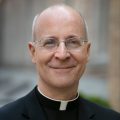
James Martin, SJ

 Politics
 Faith
Faith Culture
 Vatican
 Scripture
 Podcasts